You Already Know Something's Wrong
You've tried optimizing. You've added tools. You've hired consultants.
But the real issue isn't efficiency - it's dependency on specific people.
When one person leaving would cause chaos...
When decisions bottleneck in the same place every time...
When "how we do things" lives in someone's head instead of the system...
That's not a performance problem. That's a stability problem.
What Stabilization Means Here
When I talk about stabilization, I'm not referring to optimization, automation, or growth.
I'm referring to structural steadiness - the ability for a business to run on clear systems, decision logic, and ownership without relying on specific people to keep it running.
This is design work.
Not execution theater.
And not something that requires me to stay embedded.
How the Work Shows Up
Once dependencies are visible, the work typically takes one of three forms.
The goal is always the same: replace people-dependence with clear structure - and then step back.
Systems Audit + Solution Roadmap
Building structure that holds
Scenario:
A founder realized she was the only person who knew how to price custom projects…
What changed:
We designed a pricing decision tree, documented criteria, and created a handoff process.
Outcome:
The system now runs on structure, not memory.
Stability Sprint Day
Correcting strain & bottlenecks
Scenario:
A leadership team was meeting 12 hours a week but still missing deadlines.
What changed:
In one focused session, we redesigned the decision matrix and operating rhythm, cutting meeting load by two-thirds.
Outcome:
Pressure removed without adding complexity.
Business Architecture™ Report
Turning shared knowledge into owned IP
Scenario:
A speaker, teacher, and workshop leader assumed his value was only what he shared in the room.
What changed:
We uncovered frameworks and methodologies he'd been giving away for free, then documented and packaged them as protectable, sellable IP.
Outcome:
A repositioned business and mindset, from "shared knowledge" to owned assets ready to license, teach, or sell.
This work is design-first, time-bound, and built to stand without me.
Different forms. Same principle: design stability, then get out of the way.
What This Work Is - and Is Not
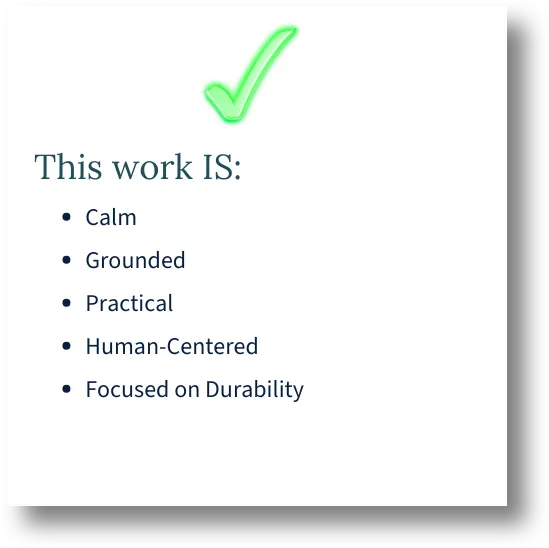
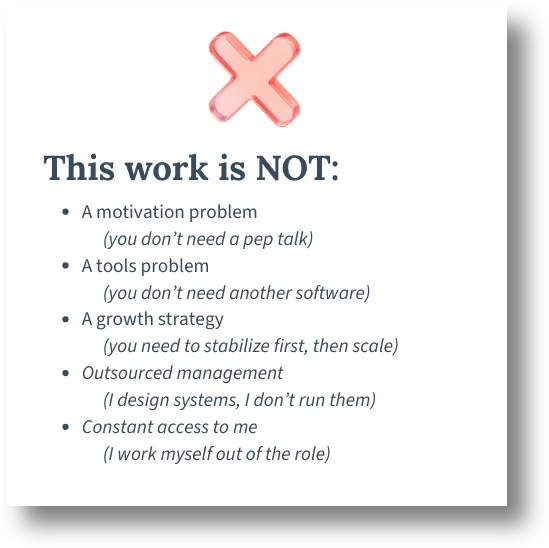
If you're sensing a strain in a system that technically works, the next step isn't more effort, it's clarity.
Ready to See Where Your System Depends on You?
Most leaders sense the strain but can't pinpoint where it's coming from.
The Stability Diagnostic maps your dependencies, bottlenecks, and single points of failure in 3 - 5 minutes.
You'll receive a personalized stability map identifying your 3 highest-risk areas and what to address first.